
News:

Take a look at what's going on, at The Town Crier!

Main Menu
Menu

Show posts

This section allows you to view all posts made by this member. Note that you can only see posts made in areas you currently have access to.

Show posts Menu

Messages - indiekid

#1
Exilian Articles / The Backpacker Capital: Escape
October 11, 2026, 08:55:26 AM
The Backpacker Capital: Escape
By indiekid
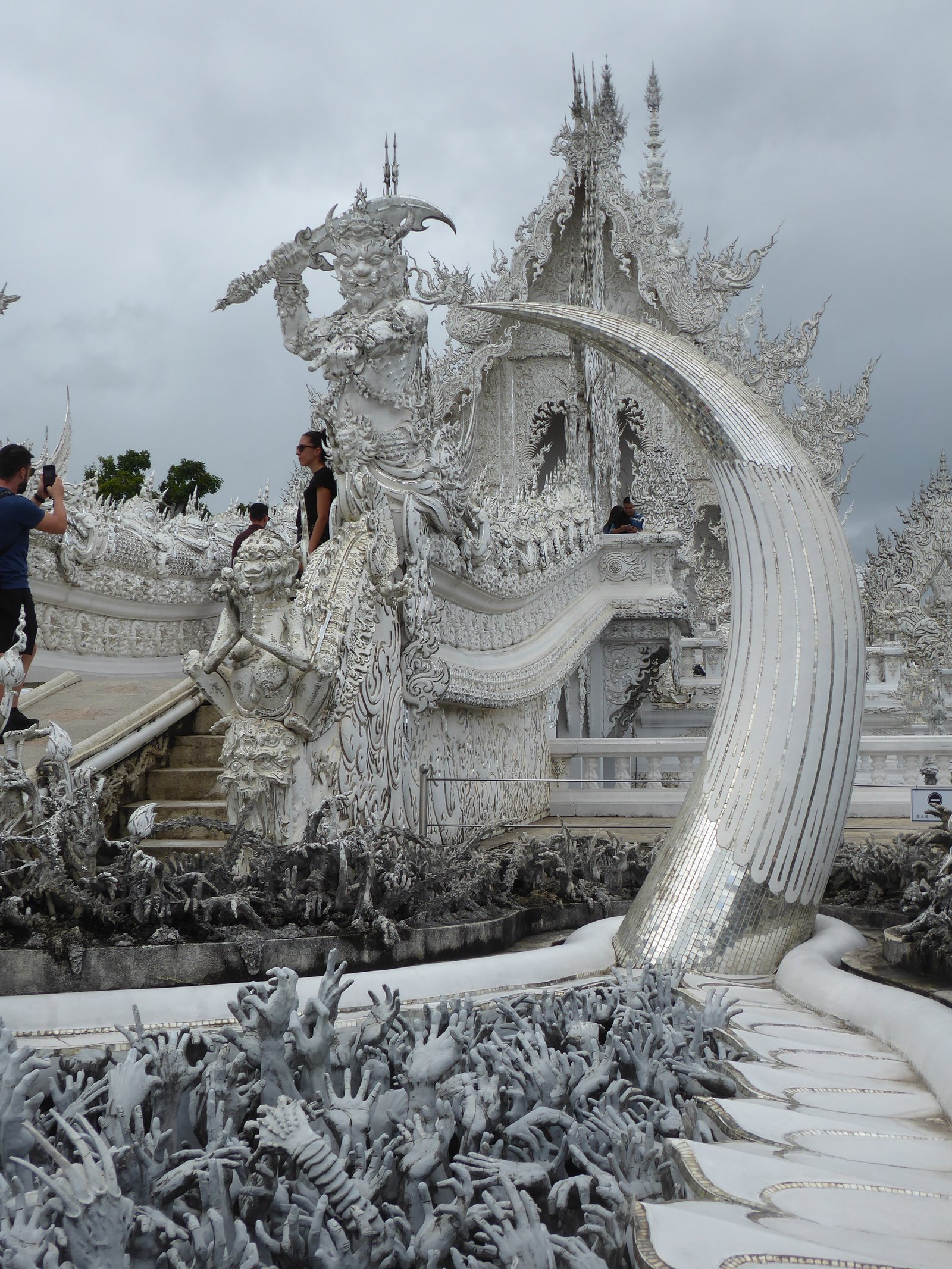

The White Temple, in all its holy strangeness.


Editor's note: this is the second part of a two-part article. You can read part one here, and find Exilian's general travel writing index here.


Northern Thailand is home to a number of different ethnic groups collectively known, to the outside world, as "hill tribes". They are distinct from other Thai peoples and largely disadvantaged as a result. They have historically lived in the mountainous borderlands of Thailand and its neighbours, though some have emigrated from as far afield as China. They number about one million in total and, though very diverse, have a few features in common: a semi-nomadic lifestyle; distinctive building techniques and a history of persecution and flight. The Yao people, for example, are native to Vietnam and southern China and were displaced during the Vietnam War (I'll spare you my rant about that). They are known to tourists for their long hair and colourful outfits. It was among these hill tribes that my hypothetical gap year back in 2011 would have taken place, and my base would have been the city of Chiang Rai – my base of operations for this, the second part of my tour of the North.

I stepped off the bus, looked around and breathed a sigh of relief: everything was refreshingly normal. After the strangeness of Chiang Mai and Pai it was nice to walk along a pavement towards a roundabout. This roundabout housed the centrepiece of the city: an elaborate golden clock. Around it I found a number of streets containing tea shops and jewellers - two of the city's specialties - but no hostel. By the time I found one I was hot and tired; I practically fell through the door into the small communal sitting and dining room. There was no one about, but my noisy entry had attracted attention. A door opened and Mekhala, the owner, appeared and, though a little surprised, asked me politely if I was a walk-in. I confirmed that I was and, in the course of our conversation, discovered that she had recently bought the hostel and moved in with her mother and young son. It was a neat and comfortable place and I settled down under the air conditioning to wait and see who else might be about.

It was not long before I made friends with two Swiss backpackers (they weren't travelling together - it was just good fortune) and we set out together to see Chiang Rai's famous sites. First up was the White Temple (Wat Rong Khun), a dazzling and over-the-top structure which was built upon a ruined 19th century temple at the end of the last century. It is the brainchild of the artist Chalermchai Kositpipat, who has put his own spin on Lanna architecture (see part 1) and is still adding to it. Although its layout is fairly typical, it has a number of controversial details. Sci-fi style statues stand guard outside and ghostly faces seem to screech out of the floor. Things get weirder as one approaches the inner sanctum, and this weirdness unfortunately detracts from the intricate and beautiful decorations. The interior walls - where no photographs are allowed - are covered in murals. These are no ordinary murals: the gods and goddesses are eclipsed by more modern characters. Superman is shown in the sky, along with an aeroplane. Spiderman and Black Panther are joined by other film and comic book characters. I found two skyscrapers to be suspiciously similar to the Twin Towers, and one had a black serpent, perhaps representing oil, coiled around it. Was the theory that even the likes of Disney would not dare sue a temple for copyright infringement? Was the overall message that religion trumps capitalism? The whole thing left a bad taste in the mouth.
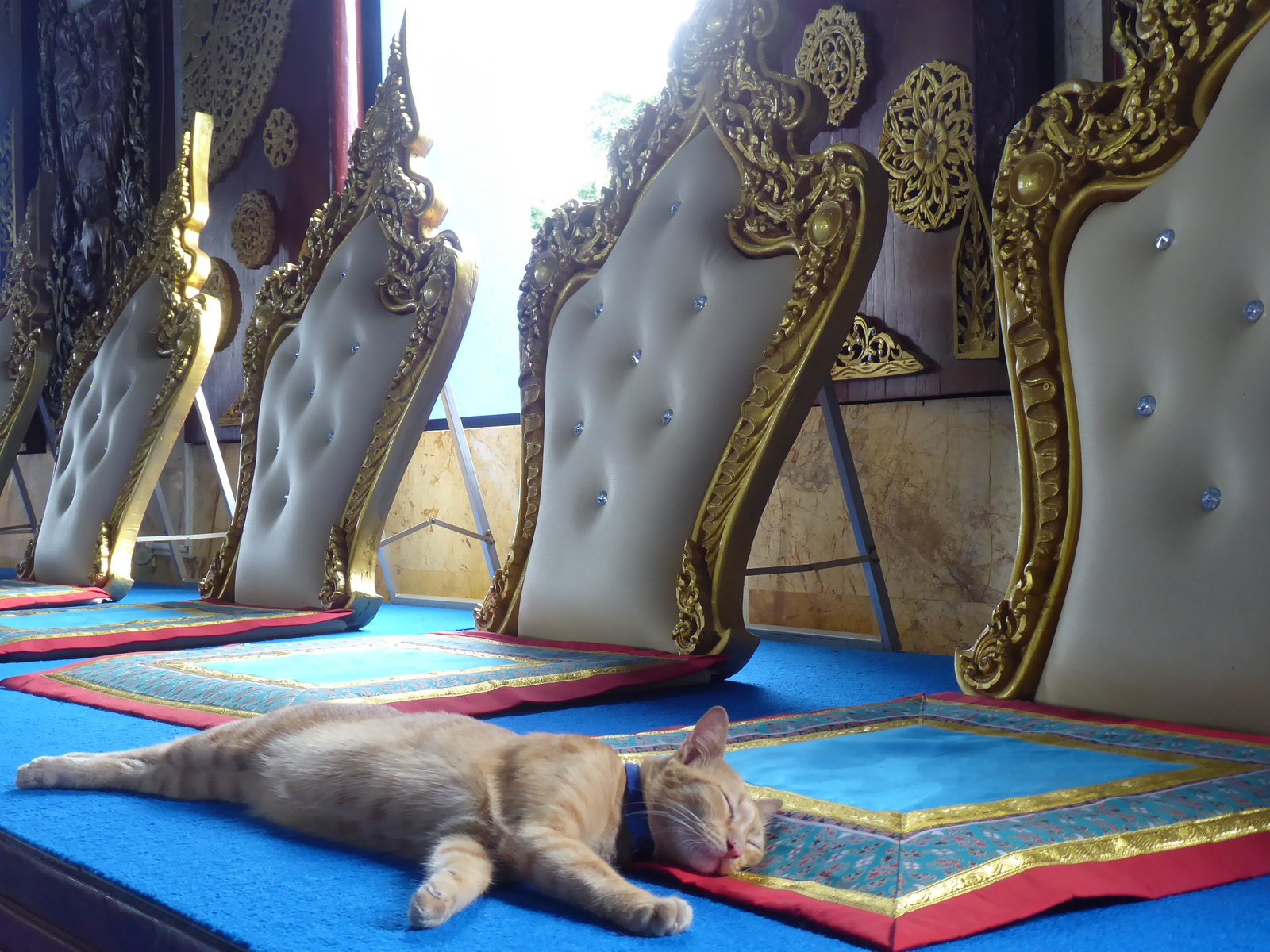


A bench in the Blue Temple reserved for monks: whether this cat had been ordained was unclear.
Our next stop was another modern building: the Blue Temple, or Wat Rong Suea Ten. This one was beautiful without being edgy, and felt more like a genuine place of worship. We had a nice time sitting in the main chamber looking at the Buddha statue which, though large, was dwarfed by the two enormous blue gods at the main entrance. We then took our final taxi (Grab is the app of choice) to the Black House (Baan Dam) Museum. This is an art gallery mostly exhibiting works by its founder, Thawan Duchanee. These include fascinating (quasi) religious paintings; human sculptures with oversized penises and much more besides. The highlight for me, however, was the architecture: the museum is spread over dozens of buildings in a shady garden. No two buildings are alike, and traditional wooden building techniques are displayed with a modern twist. It was an excellent way to round off the day.

My first solo trip out of Chiang Rai was to Chiang Saen, a small town about 60 kilometres further north. Due to its strategic location it was involved in the wars with the Burmese Empire, and was occupied by them from the sixteenth to the eighteenth century. As a result it is home to some very atmospheric ruins, and there's a nice market as well. I enjoyed walking around the temples, which are interspersed with the modern town, and encountered very few tourists. They were all of a beautiful reddish stone and some were quite overgrown. Sunlight trickled through the leafy canopy overhead and picked out worn, smiling faces in the architecture. From the temples I moved on to the imposing city walls. I remember these being very "curvy", at the gateway at least, and the main road curved with them. I noticed drivers sounding their horns as they passed the temple there. I was sure this was a religious, or at least good-luck, tradition. I was reminded of the bus driver I'd met some months before, high up in the Andes. Whenever we passed a shrine to the Virgin Mary he would take his hands off the wheel and cross himself. This was not reassuring because the shrines were usually located immediately before terrifying hairpin bends.
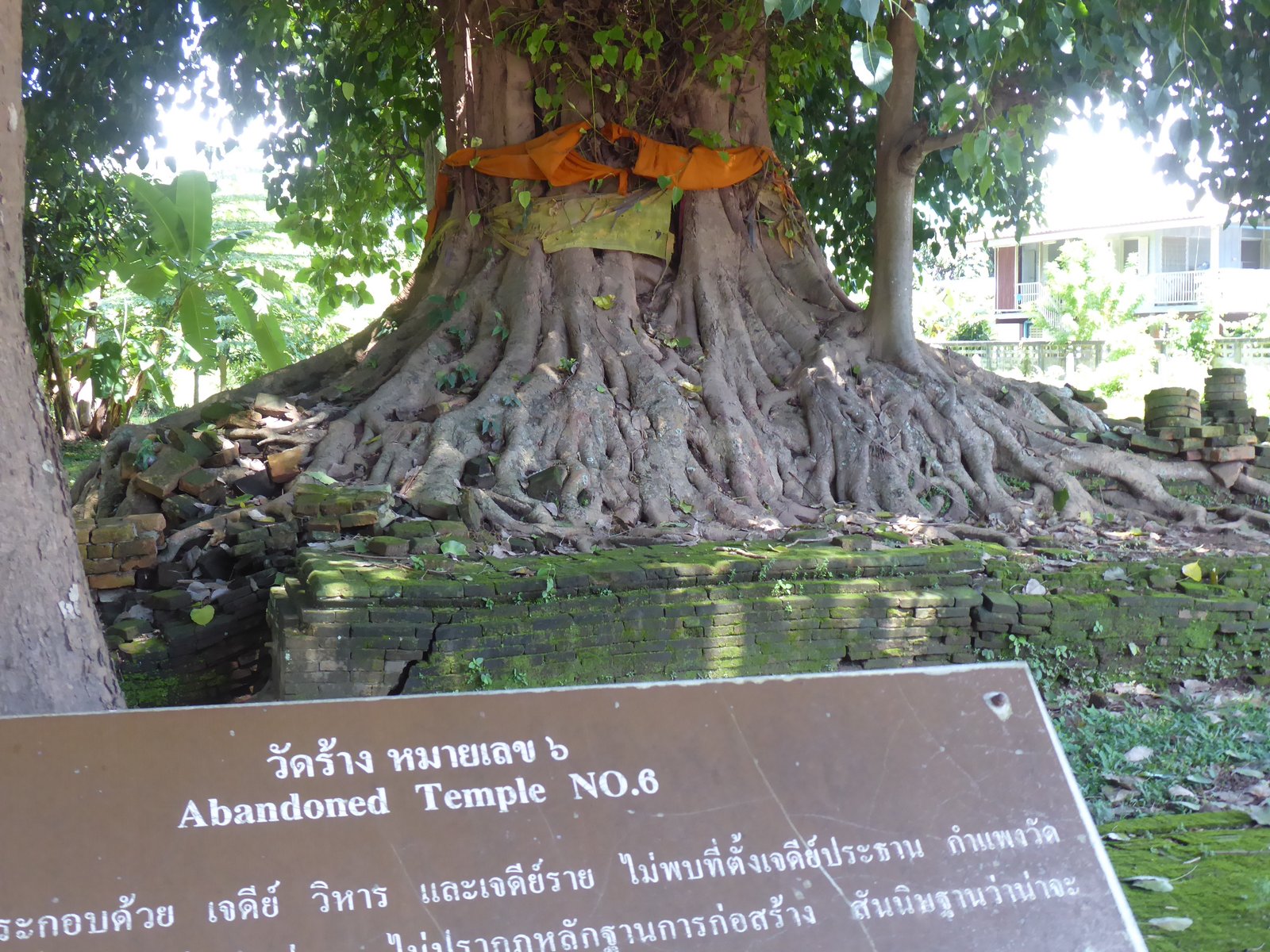


Nature reclaiming the sacred in Chiang Saen.
My next day trip began in the city of Mae Sai, which sits on a tributary of the Ruak river. This river is the border between Thailand and Myanmar, so the city is popular with backpackers doing "visa-runs". I didn't find much to see there except the big gated bridge which leads into Myanmar. From the platform beside the bridge I had a good view of the flags on the far side - I was, in that moment, the most northerly backpacker in Thailand. This was not, however, the most exciting national border to see. About 30 kilometres to the east, the mighty Mekong river (the seventh largest in Asia) forms first the border between Myanmar and Laos and then, downstream, the border between Thailand and Laos. The Ruak flows into the Mekong and their confluence is the point the three countries meet. The area is known as the Golden Triangle, thanks to its historic connection to the opium trade. I'll spare you most of my rant about that too, but will mention it includes a sarcastic use of the phrase "Rule Britannia".

It was an easy songthaew ride to the viewpoint where the sluggish brown rivers came together. A few long, thin boats plied the Mekong and a steady stream of (mostly Thai) tourists came off the main road to take photos. The contrasts between the three countries could not have been more striking. The Myanmar side was a pristine forest, broken only by a mansion-like building in the distance. I was standing in a gaudy and – as it seemed to me – tacky temple dominated by an enormous gold Buddha riding in a boat. On the Laos side, meanwhile, some glass-and-concrete skyscrapers were shooting up towards the sky. They were being built so quickly that a literal dust cloud was rising from them and blowing over the other two countries - the intended message was clear. I suspected, since Laos is such a poor country, that this display of dominance might have been bankrolled by China. When I'd had my fill of the temple, and its "loo with a view", I attempted to hitchhike towards Chiang Saen. I was moderately successful in that a car did stop, but it turned out to be a taxi. Although it wasn't quite the ride I'd expected it was still enjoyable, especially when the driver turned on my seat's massage feature (though, to be fair, this was not quite the Thai massage experience I had considered pursuing). From Chiang Saen I caught a bus back to Chiang Rai, but it's worth noting that my adventures on the Mekong were far from over: I would later rendezvous with it in its massive delta region, in Vietnam.
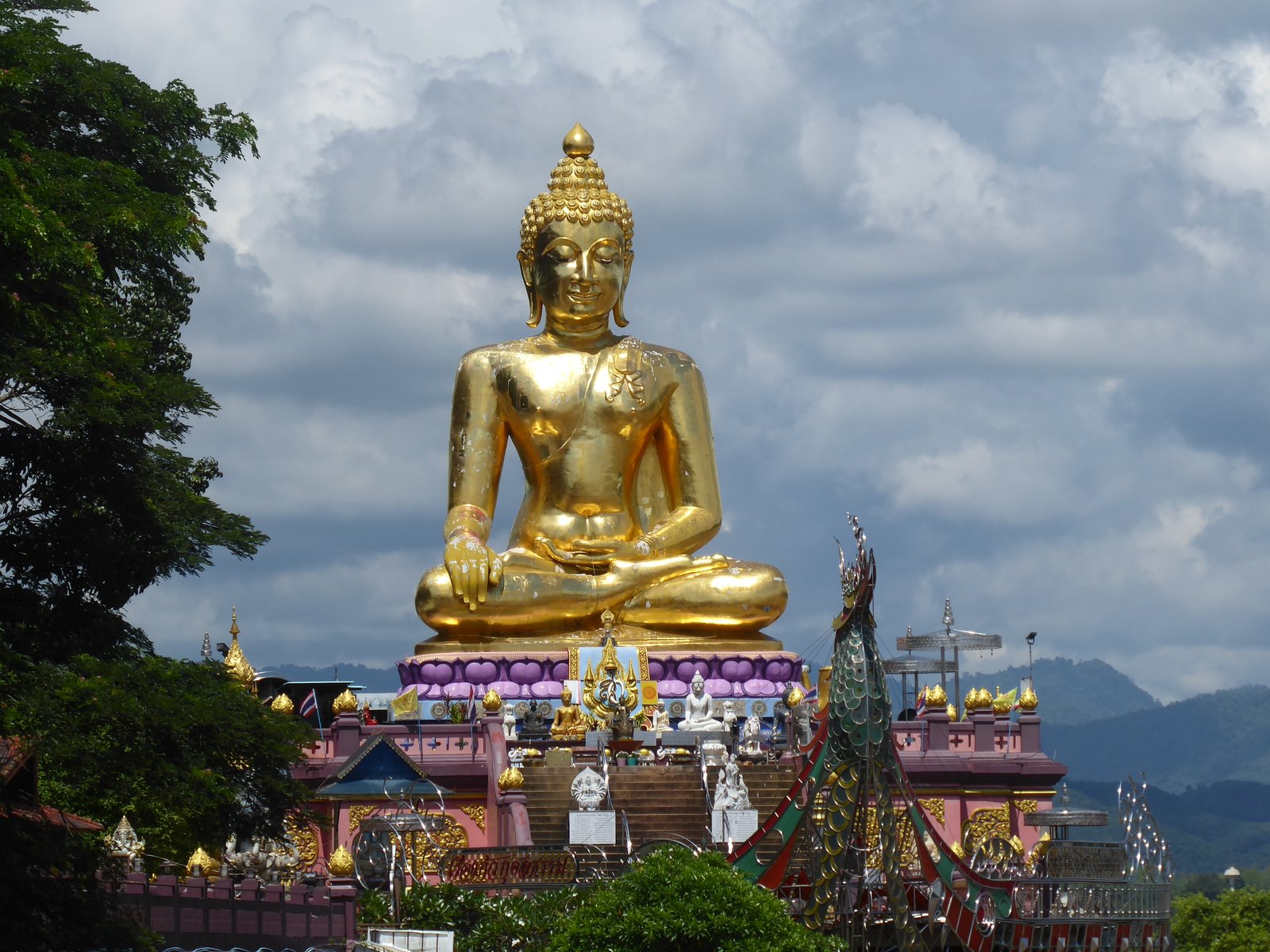


The boat of the Buddha: Phra Chiang Saen Si Phaendin temple.
In between my days out I enjoyed hanging out in Chiang Rai. I visited temples, where I looked around small museums and watched groups of orange-clad novices playing in gardens. I went to a craft fair in an old house with a connection to the royal family of Siam. I walked along the riverbank in a cloud of dragonflies. One evening I decided to take a detour to see the city's only mosque - a small but attractive building. Someone else was doing the same thing, and he recognised me: it was Kieren, my Irish friend from my hostel in Pai! We had a catch-up over some street food, then visited an Irish bar. "Hhmmmm," said Kieren as he looked around, "Not dark and smoky enough."

I was delighted to be ticking so many good experiences off my Bingo card, and soon realised I could even cross off "Homestay". For those who don't know, homestays are an accommodation option where travellers stay with a local family in their home and usually have meals provided. It's a relaxed, intimate and relatively expensive accommodation option, one my budget doesn't usually allow. So it's a credit to Mekhala and her family that this was the environment I found in the hostel. One wet evening a number of delicious-looking plates of food started appearing on the table, and the small number of guests were soon invited to join the family for dinner. "There's nothing like a bit of rain," I wrote in my diary, "To bring a group of backpackers together." It was not just backpackers who were benefiting, however: on another evening several of Mekhala's friends came over, bringing with them a heap of board games. It had been a while since I'd last given Azul a whirl, and I was pleased to finally have a go at Seven Wonders: Duel.

When the rain stopped, Mekhala took the whole lot of us out onto Chiang Rai's walking street. We looked at the different stalls and I tried every type of toasted insect in sight. We passed the park where some of the decorations for the city's annual Flower Festival (which I'd missed) are stored. Mekhala had recently told us that one of the advantages of her new home was its proximity to her son's school. Only now did she mention that it was also very close to her favourite bar, a few blocks from the walking street. So we wound up there with beers in our hands listening to some live music. The band was a young and cool four-piece; they mostly played punk numbers but also did a good cover of John Denver's Take Me Home, Country Roads. The set was perfectly smooth, precise and well-rehearsed, but a part of me wanted to gently shake someone and point out that these things do not a "punk band" make. I think this cynicism was motivated by fatigue; I had, perhaps, been down one too many country roads by this point.

I was becoming jealous of the long-term volunteers in the hostel, most of whom would get on with their digital nomad roles once the breakfast was cooked and the beds made. I knew, however, that I couldn't settle down: I had yet to achieve my most important objective. I hope I won't sound preachy - or hypocritical - when I say that I want this article to be about the ethics of backpacking. It's not just over-tourism that can be damaging: various tourist activities cause problems, and Brits like me are experts in this field. Smart tourism companies have recognised this concern and now market themselves as "ethical", which they use to justify higher prices for their services. The problem, of course, is that the claims can't be verified, especially by a lone backpacker out on the road. The contrast with, say, a decade ago is most striking in the case of elephant experiences. Companies which once promoted themselves with the phrase "feeding the elephants!" now screech "NO feeding the elephants!" for the same reason. Riding is especially frowned upon, but one man who worked in the industry shared his mixed feelings with me. Is it really so bad if a trained mahout rides the animal in a traditional and, as far as possible, kind way for the tourists' sake? He believed the new attitude threatened livelihoods. I didn't know what to make of it, but I knew the story could get a lot worse. Instead of going into it I'll provide you with a link to an article, by a Bangkok journalist, on Thailand's least ethical form of tourism below.

I needed to get out into the sticks and meet some members of the hill tribes. I wanted to do so in a way that was ethical and did not break the bank. I did not want to be seen as a big, dumb tourist with more money than sense. Something, clearly, had to give. I reasoned that my best chance of success might lie with the nearby Hill Tribe Museum, which was also the public-facing part of a large NGO dedicated to improving the lives of the local tribespeople. It was a great place to visit in its own right, the collection of traditional clothing being particularly fine. The receptionist was a little surprised when I asked about tours because it was low season. They advised a tour was possible but I would have to source other backpackers myself if I wanted to share the cost - I failed in this. It was more expensive than those offered by tour companies by about 50%, and backpacker logic dictated that I should really think twice. I considered it more likely to be ethical and genuine so decided to go ahead, though I wished I could have discussed it with the Elders. When the morning of my tour came I laced up my battered shoes, shouldered my day pack and prepared to go, quite literally, against the flow.
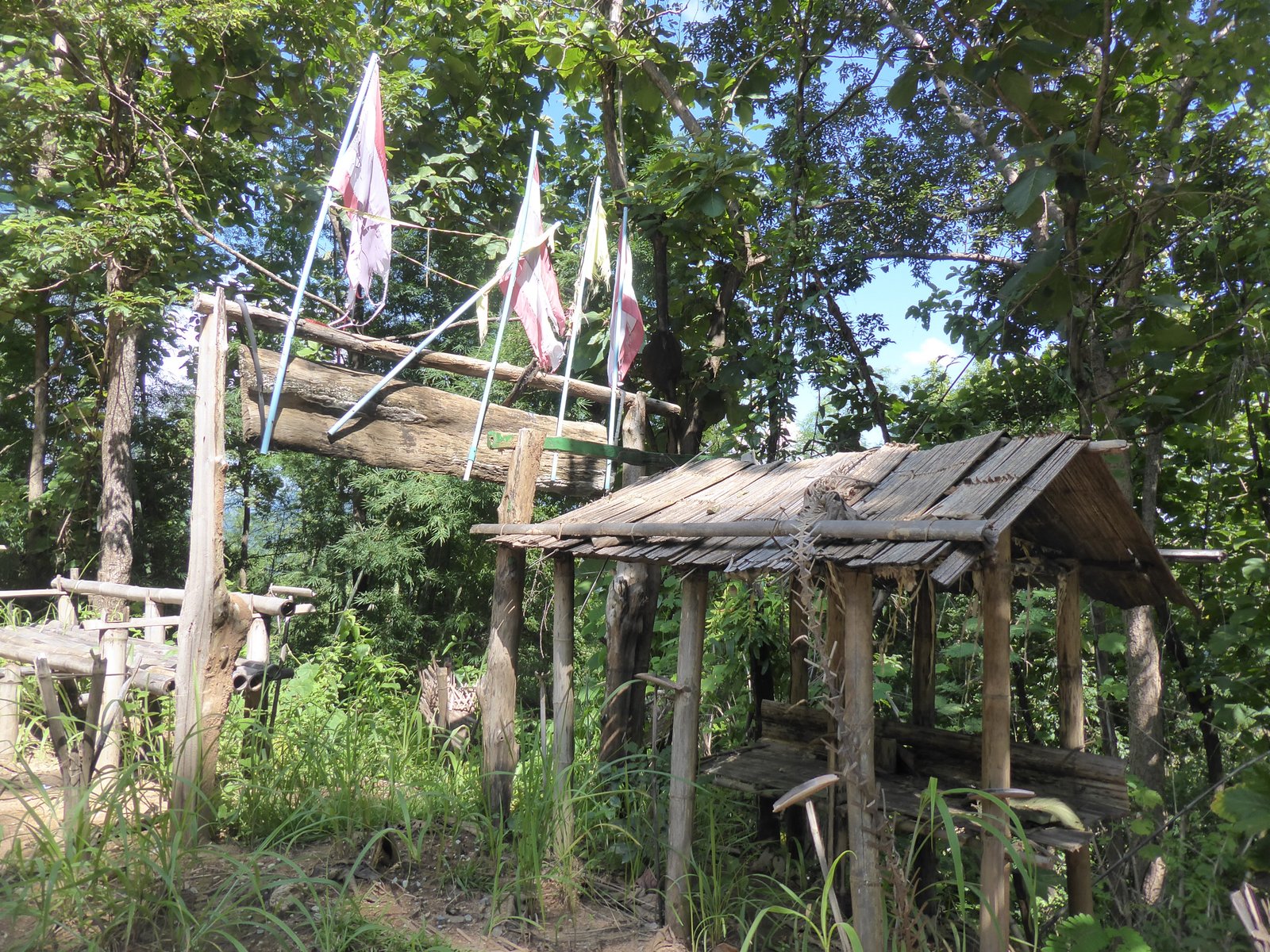


The shrine at the entrance to the Lahu village.

I stepped gingerly into the wooden boat, strong hands guiding me down. I plonked myself on one of the many benches and Goja, my guide, joined me. The boat was a ruea hang yao or "long-tailed boat", shaped like a canoe and with capacity for about twenty people. Our pilot started the engine and we set off up the Kok river. It was a relaxing ride with greenery all around; the landscape was mostly flat but with some dramatic lumpy hills here and there. Goja, a member of the Lahu tribe, was initially not very confident with his English, but was still able to point out the interesting agricultural and religious buildings we passed (his confidence grew during the day and he would later tell me about his own life in Chiang Rai state). As we rounded one bend two more ruea hang yaos came into view. Both were lying relatively low in the water, full as they were with ageing Western tourists. We waved to each other as we passed and I felt very aware of my beard, which was by now long enough to flap about in the breeze.

We pulled up at a covered wooden jetty with a sign reading "Meet the Big Snake!". I was practically bundled out of the boat by a group of smiling men and asked which of the two big snakes I would like to drape around my shoulders. I replied, without thinking, that the biggest of the two would be the most appropriate. One man offered to take my camera and, while he prepared to take my photo, the others uncoiled the snake. It was long and elegant with beautiful white scales - I seem to remember it was a python. I couldn't really appreciate the sight, however, because I was preoccupied by the very big snake's very small box. In a trice the heavy creature was around my shoulders and the photo taken: irrefutable evidence that I was a dumb, grinning tourist. I sighed inwardly and told myself that I had done everything possible in advance to make this an ethical adventure. It was time to let go and try to enjoy the ride. The snake, however, had other ideas: perhaps mistaking my lower leg for a branch it fastened itself tightly and refused to budge. This led to a lot of hopping on my part and tugging on the part of the men. This hilarious scene was not, unfortunately, caught on camera. After this a chatty man showed me his collection of coins.

With my cheeks reddening I followed Goja away from the jetty and up into the village. He informed me that the first objective of our tour had been achieved: I had just "met the Karen". The Karen are, by population, the largest of the hill tribes and are native to Myanmar; many in Thailand are refugees. This gave me pause for thought: the tour was about meeting people and seeing their day-to-day lives - if those lives involved keeping coins and pet snakes then who was I to complain? What had I been expecting, a song and dance? Whirling ceremonial clothes with no ceremony? I'm pleased to say that the day became less tourist-centred from this point onwards, largely thanks to Goja's skills and social interactions with the people we met. I was, however, still reeling a bit when we reached our second destination: an elephant corral. It was a nice place by the river and seeing elephants is, as you'd expect, nice, but I don't have much to say about it. I noticed the elephants' ears were very red in the heat. Goja explained that, while these elephants were taking their turn with the tourists, their families were living their best lives up in the hills. I chose to believe this was true.

Goja and I continued on foot, steering well clear of the pretend "village" where members of the Kayan tribe are forced to sell handicrafts and smile for the cameras. The money from these operations invariably lines the pockets of unscrupulous business owners, leading to the phenomenon being dubbed the "human zoo". We turned off the tarmac onto a peaceful track by a paddy field and I instantly relaxed. We climbed up a valley, passing fields of pineapples, cashew nuts, lemongrass and chilies; some had workers tending them. We started to get brilliant views. It was very hot and sunny – I had expected rain. We took shelter in a little hut used by the farmers and Goja told me about life in his village, which was a little further into the hills than the one we were aiming for. He faced a daily challenge in taking three children to two different schools in the morning using only one motorbike. How he met this challenge I'll leave to your imagination.

In further pursuit of shade we veered from the main path and Goja part-hacked a way through forest towards an agricultural clearing. As a result of this shortcut we approached the Lahu village from below, accentuating a dramatic architectural feature I had been looking forward to: stilts. I was to eat my lunch in a bamboo building with a corrugated iron roof on concrete stilts (concrete replaced wood when the government imposed permanence on these semi-nomadic slash-and-burn farmers). We climbed a flight of steps to a veranda covered by a brightly coloured mat. There I was met by my hostess and her two children. I did not ask to take photos of them – a rule I had imposed on myself – but did do so inside and outside the house. A table was unhooked from a wall and I sat cross-legged while it was piled high with soup, rice, chicken and papaya. It was a delicious meal and very welcome after the morning's exertions. Goja took out his knife and started chopping at some of the bamboo he had collected on the climb, chatting to our hostess as he did so. He chose a natural intersection between segments of bamboo and chopped until he had made me a drinking cup, scoring the outside as decoration. He asked me if I'd like to have a go at making one and I said something about valuing my fingers.

We said goodbye to the family and made our way through the village. There was only one road and the houses were laid out in a way that looked unplanned. This didn't really matter because there was space for all the village motorbikes among the stilts, next to the washing lines and hammocks. It was deathly quiet: everyone, apart from our host family, was out working the fields. At the top of the hill we passed a shrine, complete with brazier for burning offerings. Though all the hill tribes have adopted religions like Buddhism and Christianity, their traditional "animist" beliefs are still very much alive. These beliefs involve protecting the village from malign spirits of the forest, hence the shrine's positioning at its entrance. It served as a defence but, it is believed, defences like these sometimes fail (I'm talking in general terms – I'm not sure exactly where the Lahu sit on this). A woman conceiving twins is considered evidence of this failure and, though now rarely banished, she can still find herself ostracised by the community. I wondered, not for the first time, if it was possible to be simultaneously angry at and sympathetic towards another culture.

We had now reached a forest of teak. Teak is a sought-after hardwood because it grows incredibly slowly, so even the oldest trees looked very small to me. We had a very beautiful, though sometimes scratchy, trek up there. We passed a web strung between two trees where a huge spider (possibly a Giant Golden Orb-Weaver) was gobbling something up. I was hot and sweaty by the time we reached a waterfall. It was very picturesque and something about its speed and the long cutting it had eroded in the rock funnelled cool air towards me. I paddled, though Goja encouraged me to actually swim. We walked down a path to where the pilot from our morning boat ride was waiting, this time at the wheel of a four-by-four.

We drove to our final destination: an Akha village. I watched women in nice headwear shelling some very pink peanuts. I was shown into a house and chatted as much as was possible with the residents. There was an opportunity to buy handicrafts but no one was much bothered about this. I reasoned that this might be an advantage of doing the tour alone, with a guide who was no stranger to the community. As we made to leave I caused some excitement among the children playing in the street, many of whom were wearing t-shirts emblazoned with Disney characters. We drove back towards Chiang Rai, stopping to take photos whenever I wanted. I took a cheesy one with Goja and, at the end of the tour, shook hands with both men. I had enjoyed myself immensely: the day had been everything I wanted and, as you've seen, more. It was well worth the investment and the best outing of my trip, pushing even the Andean paragliding into second place.

On Sunday I went to church. It consisted of two church buildings: a little one, the city's oldest, and a very big one where the congregation actually gathered. A number of different people stood up to take different parts of the service, and there was a good choir. The person who worked hardest, however, was the translator. Though unseen, he kept up a constant stream of live translation through my earpiece during the spoken sections. He looked tired when I met him at the end and expressed my thanks. A husband and wife invited me back home for lunch, and I gladly accepted. I had a happy stroll in their garden, which was looked over by yet another giant white buddha. Taking pity on me for the holes in my t-shirt, my hosts gave me a new one. It carried corporate branding and was left over from some conference or other. I was touched by the gift, and moved by the whole experience, but the day was tinged with sadness: my adventures in the North were coming to an end.


Chiang Rai's airport terminal was not very interesting. It was all concrete and the waiting area was as generic as they come. I was there because of an uncanny turn of good fortune - the thirtieth or fortieth, if you're keeping count. Two friends from my past lives were in Thailand at that moment, and I was flying back to Bangkok to meet them. I was, nevertheless, feeling tired and grumpy, and already forming a mental picture of the utopia-dystopia which I would one day christen the Backpacker Capital. In my pocket my fingers closed on my latest souvenir. The church service, though very enjoyable, had one alarming feature: communion had consisted of individually-wrapped bread wafers and one-use plastic shot glasses for the wine. I had kept my shot glass out of protest because I, apparently, cared about the environment.

Here, then, was the rub: I had only been able to save this shot glass from landfill by flying from the UK to Thailand via a large number of countries. I had tried to compensate for the carbon-spewing nature of my trip by minimising internal flights, yet here I was, waiting for one. There were alternatives, but my time in Thailand was severely limited. This was due to a visa issue - the very thing that had aborted my planned trip to Thailand back in 2011. If the same world that had twice denied me a long visit to Thailand was expecting me to spend 24 hours rattling back to Bangkok on a night bus, it had another thing coming. I found the greed of this statement repulsive: the world did not owe me anything. Despite this, it had given me a tremendous amount, far more than it had given others. This is my intended take-away of this article – all of them, in fact. If you're reading this, you know that this world gives. It gives and it gives and it gives. One way we can share this is by putting pen to paper, as I've done here. Thank you for reading and thank you, Jubal, for editing (and for the conversations about the wildlife and culture).


Links

As promised, here is the article about unethical tourism: https://www.thaienquirer.com/52358/opinion-spare-a-thought-for-thai-sex-workers-during-pride/

I also feel compelled, on this occasion, to link to some of the organisations which made my trip so special. Here is the cooking school in Chiang Mai: https://www.asiascenic.com/

The hostel in Chiang Rai: https://www.facebook.com/people/Together-Backpackers-Hostel/100091812953854/

The Hill Tribe Museum: https://www.pdacr.org/general-information-2/

Editor's Recommendation: the Irish Pub song. As this piece proves, there really is one wherever you go in the world.
#2
Master of Olympus / Re: Development Diary
September 19, 2026, 09:29:43 PM
#3
Master of Olympus / Re: Development Diary
August 30, 2026, 02:38:08 PM
Been doing a lot of writing recently, and this one is another new-ish style https://masterofolympus.wordpress.com/2026/08/30/diary-78-jamey-with-a-y-and-i/
#4
I'd like to come along, Friday slightly better for me. I've got stuff on though so would be rocking up about 10pm
#6
The Backpacker Capital: Arrival
By indiekid


The chedi (stupa) of Wat Chedi Luang.


A long way from here there is a city. The streets are clean and the weather is agreeable. Viewed from a distance, the city's skyline is uncluttered and pretty. This is thanks, in part, to its varied and interesting public buildings. Though some of these buildings may be the relics of a colonial past, this city has embraced them, made them its own and uses them to paint a bright future for itself. Many groups and societies meet in the city, including the Elders of Backpacking. It is they who keep an eye on world events and inform travellers of new risks or opportunities. Every year they compile bingo cards to guide the more competitive types to the most exciting destinations and experiences. There's time here for religion too: most visitors partake in yoga and mindfulness, but a few die-hards still pay homage to the Hippie movement of the twentieth century.

In the Backpacker Capital there is free WiFi on every street corner. Getting around is easy: the tuktuks carry up to five passengers, the motorbikes ten. Teleporters hover at intervals to whisk backpackers off to their next destination in a heartbeat. Drugs are readily available but technically illegal, so users can still get a kick out of breaking the rules. There are no hangovers, stomach bugs or bouts of homesickness. There are, of course, a lot of people behind the scenes keeping the place running smoothly. Visitors, however, rarely take much notice of them - except when on an organised tour to one of their quaint little villages. Did I mention that everyone speaks English? Even the crowds of drunken Brits give it a good shot.

This city, of course, does not exist. If it did, the backpackers of the world - fickle as they are - would swiftly label it as "too touristy" and drift off somewhere new. There are, however, a handful of cities worldwide which come close. Usually located where popular itineraries meet, these cities are so saturated in the travel "vibe" that it has formed a local sub-culture of its own. Examples from my own adventures include San Cristobal de las Casas, Mexico and Edinburgh, Scotland. This article, meanwhile, is about Chiang Mai, Thailand. I, like many travellers, arrived by train from Bangkok. So find your berth, buckle up and wrap up warm against the vicious air conditioning: the North is calling, and I'm glad you've come along for the ride.


It was 3am and I couldn't get back to sleep. Dawn had yet to illuminate the misty hills through which the train rumbled, but I had my nose pressed up against the window even so. I had felt an excitement similar to this before - every time I approached a new destination, in fact. This time, however, it was personal. It was in this part of the world that I had almost had my first backpacking adventure many years previously. Due to visa issues I pivoted to India and, though I had a great time, Thailand remained lodged in my imagination. In the intervening years I had come to understand the positive impacts new places and people had on me personally. I had left some of them, Medellín, for example, so energised I felt I had been "modded". Would I have wound up a different person had those experiences not happened, had I turned right instead of left? In Chiang Mai I hoped to find the answers to some of these questions. I was expecting, to stick with the gaming analogy, to put on a new "skin" - one which had been waiting for me since I was eighteen years old.

At the station I took a songthaew into town. These are pickup trucks converted into buses by the addition of benches and an awning. The city centre was easily identifiable by the moat and impressive stone walls. These are arranged in a 1.6 kilometre square and enclose many of the city's sites. I had not booked accommodation but was fortunate to stumble across a nice family-run hostel which even did food. I was initially the only backpacker in my dorm so I essentially had my own room for the cost of £3 a night. It was the rainy (ie. low) season, which meant it was a bit too hot to do anything until the afternoon thunderstorm broke. When the storm passed I set off in search of the city's "walking streets".


A flag outside the where the pillar of Wat Chedi Luang is stored - this is all that women are allowed to see.
Chiang Mai's centre was calm and quiet - remarkably so, considering it is Thailand's second city. Throughout the year whole chunks of it close to traffic and turn into markets. These focus on food, and I have to say Thailand lives up to its reputation in this regard. Big displays of seafood; skewers of meat; great hotplates where noodles are practically tossed around... I could go on. Let's just say I ate well without breaking the bank. In some places the markets occupy open spaces with musicians entertaining the diners. Most were lone singers on guitar and vocals doing Western songs - I think I heard three different renditions of John Denver's Take Me Home, Country Roads. On the way back to the hostel I passed bars full of westerners playing pool, and took in a furious Muay Thai boxing match.

My plan for the next few days was to visit Chiang Mai's many temples. My first stop, however, was the Lanna Folklife Museum, which is housed in a beautiful building with interiors of teak. The Lanna culture dominates the area around Chiang Mai, but it's worth noting that Northern Thailand as a whole is very diverse. The Lanna practice Theravada Buddhism and, though there were many items of interest in the museum, it was their religious art which really made an impression on me. They make Buddha statues and statuettes in just about every material imaginable. They portray him with long facial features, especially the ears, and hands in one of the mudra positions, each of which has its own meaning. Thus prepared, I headed out to see the temples. Architecturally they had various things in common, such as snake-like nagas - semi-divine beings found in various Asian cultures, sometimes with human or bestial characteristics - undulating down their staircases, and steeply-curving wooden roofs over their porches (the latter proved to be useful shelters during the sudden rainstorms). Rather than go through the temples exhaustively I thought I'd focus on one of the most important.

Wat Chedi Luang stands on one of the old city's main North-South thoroughfares. It consists of a large ruined stupa surrounded by various buildings. These include shrines, museums and accommodation for the monks. There are candles burning and gongs for visitors to sound on the paths. The most important building, situated near the entrance, is relatively small but nicely decked out in green and white. It is possibly the most sacred place in the city because it houses its pillar: the Inthakhin Vihara. It was here that I came across a discriminatory regulation which will be depressingly familiar to students of religion. Women are not allowed to enter because they menstruate. I wondered, not for the first time, if it was possible to be simultaneously angry at and sympathetic towards another culture.


The beast-lined stairs to Wat Phra That Doi Suthep.
One morning I took a songthaew up the hill to Wat Phra That Doi Suthep. This is another hugely important temple and pilgrimage site. It's only been accessible by road since 1935, and many visitors still choose to climb the gruelling Monk's Path instead. Considering they have to explore the temple without shoes on (and with legs covered, as usual) I was glad of my choice. The approach to the temple is a dramatic flight of naga-lined steps which cuts through the forest. I was equally impressed by the doors of the various temple buildings, which were gold in colour and adorned with mythological characters and creatures. I missed out on the famous views over the city because the mountain was shrouded in mist. After my visit I cooled off in a little wooden hut over the water on Lake Huay Tung Tao.

The highlight of my visit to Chiang Mai was my day in a cookery school. This was held in a one-storey building with several benches of cooking stations. There were about twelve of us booked onto the course and, thanks largely to the welcoming host, it was a very sociable day. I met several Americans, and an Irish couple, Callan and Cat, who had come over from Vietnam. We started in the garden where some of the ingredients are grown. I was bitten by a mosquito during the talk, so we were able to test the painkilling effect of the turmeric root in situ. Before returning to our woks we headed to the local market for more ingredients. Although we cooked a variety of dishes, with choices at each stage, there was a fairly consistent ratio to remember: one spoonful of palm sugar to two of fish sauce to three of oyster sauce. Behind the scenes, an army of staff did our washing up and, presumably, giggled at our poor - and sometimes hazardous - wok technique. I made spring rolls, Pad See Uw, Tom Yum Koong soup, Massaman Curry, Glass Noodle Salad and Mango Sticky Rice. For the latter two dishes the class thinned out dramatically: these were part of the full-day course and most attendees had only signed up for a half. I felt vindicated in my decision when someone later confided in me that their afternoon back at their hostel had consisted only of "collapsing into a food coma" - we were eating our creations as we went along. I actually took most of my food away in takeaway boxes (this is one reason a cookery class is significantly more budget-friendly than it first appears). I made some audio recordings on my phone and came away with a recipe book, which I still use.


I was having a great time in the Backpacker Capital, but it was clear that I couldn't leave without seeing the Backpacker Playground. Though a detour from my planned itinerary, the town of Pai held an irresistible lure. Sometimes described as a "beach town in the mountains", Pai boasts a combination of beautiful surroundings and a chilled-out vibe. The staff at my Chiang Mai hostel were kind enough to let me leave my big bag while I headed for the bus. I found, to my surprise, two minibuses instead of one large bus. The reason for this soon became apparent: the road, though good quality, was narrow in places and very steep. The journey took us around innumerable hair-pin bends which were - in the case of the unfortunate occupant of the back corner seat - literally vomit-inducing. It was with a sense of relief that I arrived in Pai and started exploring.

The town's main street wound its way past quirky bookshops and little cafes with backpackers lounging around outside. Across the river, the thickly-forested hills promised exciting motorbike adventures. Jutting above the trees was the big white Buddha of Wat Phra That Mae Yen (how are you getting on with these names, by the way?). I walked the two kilometres towards it and climbed the big white staircase. I joined the ten (ish) meter-tall statue in admiring the view of the sunset. The Buddha was portrayed seated with one hand in his lap and the other on his knee: the mudra which represents "calling the Earth to witness". I descended the steps and followed the road back; I remember the rice paddies looking very beautiful in the twilight.

I was unaware that my evening was about to get very interesting. I paused by the roadside to examine a big flying insect which was stuck on its back, and a motorbike pulled up alongside me. On it were two backpackers, both sensibly wearing helmets, who were more interested in me than the unfortunate insect. They were Callan and Cat, my friends from the cookery school! We had a brief catch up then agreed to meet at a bar. I returned to my simple hostel, smartened myself up as best I could, then headed out into the night. The bar, once located in its narrow alley, was nicely decorated with cushions and coloured lights. I joined Callan and Cat in listening to the live music, which included good covers of Darius' Colourblind and John Denver's Take Me Home, Country Roads. I drank a few Black Russians, the only cocktails on offer which weren't a huge dose of citrus and sugar. I felt a little out of place amongst the bar's uber-cool patrons, but still had a nice evening.


A distant Buddha statue watches over the Pai river.
My alarm went off at 6am the next morning. My dry mouth and pounding head protested at getting up, but it was necessary if I was to reach Pai's canyon on foot. I set off down a long, straight road which took me past some strange religious and backpacker-esque junkyards. Broken statues and bits of shrine mingled with a flower-covered Rolls-Royce and a wrongly-proportioned red British phone box. It started to rain. The view of the canyon, when I reached it, was a bit of an anticlimax due to the tree cover, but there were some nice birds around including a spotted pigeon and a young blue rock dove. I had been reliably informed that there was a good adventure to be had in ignoring the warning signs and exploring the crumbly sandstone outcrops. I did not find this course of action appealing, so instead headed back to a cafe in the car park for some breakfast. There I was fortunate enough to meet an American who was exploring temples (partly at his employer's expense) for research purposes. He seemed a good person to ask some of my questions about Buddhism. Why, for example, was I seeing statues and paintings of the gods and goddesses I associated with the Hindu pantheon? I won't try to replicate his answer here but you could do your own research or, even better, take part in a Talk to a Monk event at your local temple.

The owner of the cafe helped me in my search for a taxi, but ended up taking me back to town himself. I paid a quick visit to some nice waterfalls then returned to the bus station. I had spent a mere 24 hours in Pai, and was aware that the aforementioned Elders would be most displeased with me. My plans, however, were taking me back to Chiang Mai for another bus north - as far north as was possible for me to go. I'm itching to tell you about it, but I can sense my editor's eyelids drooping, and maybe yours are too. Let's make this one a two-parter, shall we?


Editor's Note: Thanks go to John Geeson for helping with the bird identification in for this piece. Stay tuned for part two!

#7
Master of Olympus / Re: Development Diary
May 18, 2026, 10:06:20 PM
Another dive into the "tabletop gaming adjacent" https://masterofolympus.wordpress.com/2026/05/18/diary-76-brick-by-brick/
#8
Master of Olympus / Re: Development Diary
January 19, 2026, 08:52:02 PM
Stretching two of my development diaries in interesting directions https://masterofolympus.wordpress.com/2026/01/19/diary-75-needs-more-numbers/
#9
Stories and AARs / Re: The Earthwitch
December 21, 2025, 04:08:03 PM
This entry was significantly easier to write than the last: if Part 2 was me pushing a stone up a hill, Part 3 was watching it roll back down. I wrote most of it on the train to work.

The objective was to give Idil a chance to show off her abilities. We see four applications of Earthwitch skills here, but its the final one that is the most significant. Idil breaks the rule that was so firmly laid down earlier in the story. She's gone from being willing (ish) to sacrifice Mina for the sake of the Earth to willing to do the exact opposite.

The final scene is a deliberate reflection of the end of Part 2. Unusually for me I both drafted and typed up the first, longer section of Part 3 before moving on to this one. I've gone for a slightly different narration style in the latter part. There are two paragraphs that end with a "..." indicating an interruption of Mina's internal monologue. I'm not sure if this works. As always I'd welcome any opinions on this or other aspects of the story.
#10
Stories and AARs / Re: The Earthwitch
December 21, 2025, 03:57:03 PM
Part 3

Mina looked back over the valley, glad of the opportunity to catch her breath. The slopes on either side curved smoothly towards each other; it was hard to believe that the climb had been so steep and rough. As her eyes followed the slopes upwards green turned to grey, and rocky crags jutted out from the summits. Between these crags the occasional flash of silver water was visible. The water cascaded off the hills and met in the river below. Up here the river was a rocky torrent, but, as Mina  followed it downhill, it smoothed out and widened. In the distance, in the lowlands where they had started their journey, it resembled a silver ribbon. The transformation in the river as it progressed resembled the changes they had seen on their journey. Having started in farmland, they were now in wild, untameable hills: the home of sheep. Mina could see them dotted evenly around the valley, and could hear their occasional bleats.

Mina tried to take in the whole view at once, aware that she might not see it again. Her pack bit into her shoulders and her feet felt hot and damp inside her boots. She looked over her shoulder at Roy. He was standing some way above her, on a rock half-buried in the hillside. It jutted stubbornly out of the grass, crowned with moss; it seemed, to Mina, like a mountain all of Roy's own. Idil, meanwhile, stood between them, and Roy was watching her intently. Mina was not sure why: she had stood in the same position for some minutes, with one hand on her staff and the other by her side, palm open. Her eyes were closed and she was frowning in concentration. She was asking something of the woken spirit way above them, but it was taking some time to materialise.

Mina looked up: up at what she knew to be a false summit, with another summit, and another, beyond. She scanned the ridge impatiently, and saw movement between the crags some way ahead. A finger of mist was creeping along a depression, growing as it descended. It soon met another, and they wound together into a single mass. The mist grew rapidly, and Mina realised that the entire ridge must be covered just out of sight. The sunlight vanished behind a wall of white. Suddenly, as though it had become too heavy for the hilltop, the mist fell, plummeting towards them in a silent avalanche. Mina stole one last view of the landscape, but it was already becoming obscured; the sheep, aware that they were about to lose each other, were running. The mist rushed down the slope obscuring everything in its path; Mina couldn't help flinching as it struck her. With her eyes closed, she felt nothing but a sudden cold. A bleating of sheep filled the valley from above and below.

Mina opened her eyes to find the world changed. Water clung to the stems of grass and the heads of thistles drooped with it. Roy was now at the limit of her vision, and the distant cries of sheep the only reminder of the scale of the valley. When Idil nodded to him he set off without hesitation, leading them up them higher. Idil followed and Mina, suppressing a sigh, fell into place behind her. She couldn't match the others' stoicism, their indifference to the harshness of the journey, and she longed to rest. For now she could only hoist her pack higher on her shoulders and tread were Idil trod. She knew, however, that it was not just fatigue that made her reluctant to continue the climb. The mist, though it would be useful for concealing them, indicated a greater challenge ahead. For the spirit to have granted them such a gift, it must have been restless indeed.

They had not been climbing long when Idil stopped. "Roy," she called softly.

Roy did not hear her, and she had to call his name again. He turned to look back at them, almost hidden once again by the mist. Idil seemed to be listening for something, and Mina edged closer to her. From some way below, and moving down the valley, she heard voices.

"Shepherds," said Idil.

Mina tensed. She did not like meeting people: they could be cruel, and were always suspicious. They had been lucky, so far, to have avoided them in the valley.

"They'll have dogs," observed Roy.

Dogs! This was the last straw: the mist would be useless against the dogs' sense of smell. She looked to Idil who was, as always, calm.

"We'll have to reach out to them, Mina," she said, "Follow my lead."

Mina fought to calm her nerves: they had been training for this sort of thing, after all. Never before, however, had she sent her senses into the Earth under such pressure. With a force of will she closed her eyes and took a deep, calming breath. She focused downwards, to her feet and the tangled, watery mess on which they stood. The familiar state of awareness came to her more easily than she had expected. A doubt appeared at the back of her mind, however, where she knew it would remain: why had Idil used her name, and not asked Roy to join in the lesson as well?

Having found the Earth, Mina sent her senses out to find the dogs. She was distracted, however, by the gurgling of the river and found herself there instantaneously. She had reached a small pool, fed by a tiny waterfall where the water gushed across rocks. It was dark and sheltered; a pleasant place to relax, though she knew she could not. She forced herself out and cast around the valley wildly, but was distracted again by the thundering hooves of running sheep. Finally, after holding herself still for a moment, she found what she was looking for. On the path by the river walked a group of people and dogs, satisfied after a day's work. The three dogs were easy to distinguish thanks to the rings they were running around the group. Encouraged, she abandoned herself completely and leapt into the dogs.

Mina was struck by the sensations of damp coats, hot breath and lolling tongues. She could immediately feel the dogs' sense of excitement, and the camaraderie – invincibility, even – of the pack. She shared their delight in the day's work up in the hills. In all her practise with her senses she had never felt anything like this, and she grinned in spite of herself. Through the dogs her understanding of the valley grew: she learnt of the best paths, vantage points and places to find shelter. She soon realised that, as an intruder in the valley, she would not be able to overcome their sense of smell. She, Idil and Roy would have to smell like they belonged. She focused again and searched the dogs for their favourite smell. It wasn't hard to find, as it was the place they were headed: it was in the house at the bottom of the valley. It was the room where the pack assembled, where the humans hung their coats. This was the smell that needed to fill Mina and the dogs' minds.

Idil, Mina realised, was one step ahead of her. The dogs had already picked up the scent and were running towards them, both excited and intrigued. Mina felt their hearts beating inside their chests, but realised she might also be feeling her own. The thought brought her back to herself abruptly; she could not maintain her focus and meet the dogs with her senses so far from her own body. She blinked her eyes open and drew a sharp breath; her body felt alien to her for a moment. The mist was thicker than she remembered so she found herself squinting through it as she searched for the approaching dogs. Three dark patches appeared in the mist and grew until, after a few seconds, the dogs broke free of it. They were smaller than Mina had expected: wiry creatures with water clinging to black and white coats and saliva dribbling from lolling tongues. As the dogs climbed towards them Mina realised, to her surprise, that she was not afraid.

Mina, Roy and Idil stood still as the dogs trotted over to investigate them. Wagging tails beat against their legs and the sound of sniffing filled the air. The dogs wove between them in cheerful circles, each satisfying itself that the three humans were part of the pack. Mina stole a glance at Idil and saw that her eyes were still closed. Even she could not suppress a smile, however, when one of the dogs licked her hand. Eventually the dogs turned as one to retrace their steps down the hill.

"Nice doggies," muttered Roy, sourly.

Three tails stopped wagging and six ears stood erect. Idil stepped forward immediately, hands outstretched. She crouched over the dogs as they stood still, poised and uncertain. Her concentration was unbroken; if she was angry with Roy, she did not show it. After a moment the dogs relaxed and resumed their descent. They were swallowed up by the mist as quickly as they had entered, and a whistle from the shepherds on the path guided them on their way.

Mina stood rooted to the spot, furious. She glared at Roy and saw that Idil was doing so too. Roy, though he was scowling, avoided meeting their eyes. He spun around and set off up the hill once again. Mina longed for Idil to give him a telling off, but knew she wouldn't. It wasn't the need for silence that held her tongue: she never told Roy off for his behaviour, though she was very quick to criticise Mina. It wasn't fair! Now, to make matters worse, Roy was still allowed to lead the way, at a pace Mina would struggle to match. She had no choice but to fall into step behind Idil, lest she lose them both in the mist.

The climb was hard, but not as hard as the thoughts running through Mina's head. She thought back to the lessons she and Roy had been having lately. He would get frustrated, then distracted, and Idil would have to repeat things for him. Perhaps this was why she hadn't asked him to help with the dogs. Well, Mina couldn't help it if she was better than he at listening to the Earth, could she? There was no reason for him to be childish and sabotage their efforts. Fuming, she kept revisiting the same arguments in her mind. Even so, she gradually became aware that her anger and sense of foreboding was not entirely internal. The upset of the spirit, now that they were so close to it, was contagious.

By the time they reached the top of the ridge Mina was very hot and bothered. Her damp hair clung to her head and her feet hurt. Ahead of her, Idil and Roy had paused where the slope levelled off. The mist here, though thick, was exposed to the wind, so it writhed and shifted like something alive. Its gradual parting and closing revealed a number of tooth-shaped rocks around them. Mina tried not to think of how deeply buried they were in the Earth; how much of the Spirit's fury they might share in. She lingered a little too long, and realised with a start that Idil and Roy had moved on. She caught sight of Idil's cloak disappearing into the mist between the rocks and hurried to catch up, her heart hammering, pack bouncing awkwardly on her back. The last thing she wanted was to be lost on the ridge, but she was embarrassed at how quickly she had panicked. She was glad, then, to be behind the others.
Roy found for them a narrow path between the rocks. The grass soon gave way to tough heather, and the ground was littered with little piles of sheep droppings. When they reached a more open space, Roy stopped.

"A lot of sheep have been here," he said.

Looking around, Mina saw the ground was churned up into mud by hundreds of hoof prints.

"The shepherds bring them here often," Idil replied, "They treat them for tics, then wash them in the waters of the lake."

"Is that why the spirit is angry?" Roy asked.

"No: this is something the spirit is willing to give. The shepherds, sheep and spirit have all grown together over time; they listen to one another. You know, there is something very special about this spirit," she looked from one to the other, "And I have always hoped to meet it. It has, sometimes, been known to speak."

"What does it say?" asked Mina.

"I don't know," Idil replied, smiling, "Perhaps nothing, but we will soon find out. I will lead the way now, Roy."

Mina noticed a change in Idil as they set off again: she held her staff ready in one hand and looked about warily as she walked. The feeling of anger in the surroundings grew and what was left of the daylight seemed to fade. They had not gone far when the mist abruptly parted. It was as if they had passed through a wall: mist stretched around to their left and right, but they now stood in slightly clearer air. The bank of mist formed a circle with a small lake at its centre. The surface of the lake was still and grey; long, sharp grasses grew at its edge. The lake had formed at the foot of a stack of boulders, the silhouette of which stretched away along the ridge. Boulders had tumbled into and around the lake, making the path to the bank treacherous.

Idil leant her pack against a nearby rock and looked sternly at the children. "Wait here," she said.

Idil had only taken a few steps, however, when she changed her mind and returned. She took off her heavy cloak, folded it carefully and placed it on the rock. Then she set off again, walking slightly to the right where the ground rose to meet the stack. Her bare arms looked especially pale in the half-light. It seemed to take Idil a long time to reach the lake, and Mina fought down an urge to run to her. She wanted to warn her of something she couldn't articulate, something terrible, but the silence restrained her. She hardly dared to breathe.

Ripples appeared on the lake and sloshed against the bank. They emanated from the centre of the lake, where a mass of churning water was growing rapidly. Each passing moment brought more activity, and fury, to the water; it was soon white and foaming. Mina hoped and wished that it might stop, or that Idil might be able to intervene, but it kept rising. It seemed like a solid object, though it consisted of nothing more than rising and falling water. Mina was transfixed: in her time travelling with Idil no spirit had ever chosen to manifest in such a dramatic fashion. None except the Pain Spirit.

Mina managed to push the thought from her mind, but not her body; she felt as though something had dropped from her stomach. She tore her gaze from the lake and looked at Idil, who was standing motionless. Her staff was held protectively across her body and her face was set in concentration. She showed no emotion as the tumult in the centre of the lake increased and the roar of the water intensified. The white, foamy mass rose into a pillar until it stood at about the same height as Idil. Then, in a harsh voice that completely lacked inflection, the spirit spoke.

"I cannot rest," it boomed, "While there are two."

Idil looked at Mina and Roy. Mina felt very aware of her brother standing beside her, as he always had, ever since they met the Pain Spirit. In Idil's face Mina could see that same awareness and, with it, fear. That look, though brief, told Mina everything she needed to know.

The pillar erupted form the lake and hit Idil squarely in the chest. Unprepared, she fell to the ground, her head narrowly missing a rock. The lake heaved and rushed towards the near bank. A second pillar shot upwards and arced towards where Idil lay. In the moments before it hit her she raised her staff a little, but she could not prevent herself being doused and vanishing from Mina and Roy's view. When the force of the water finally subsided, however, she sprang to her feet. Though weighed down by her wet hair and clothes she looked at the lake with the same determination as she had before. The lake launched another attack but, this time, Idil met it with her staff. The end of the staff presented a barrier the water could not penetrate, and the deflected water dissipated noisily against the rocks. Another column of water, from a different part of the lake, burst towards Idil, but she swung her staff and sent it skywards just as it reached her. Water thundered to the ground all around, spraying Mina and Roy where they stood.

Idil did not wait for another attack but strode purposefully towards the lake, staff raised. The lake responded in anger: its entire surface exploded in roaring white foam. Idil, undeterred, kept walking, beyond the bank and on to the lake bed itself. The maelstrom reached its climax, stretching upwards and spraying water in all directions. Idil was swiftly swallowed by it; when Mina and Roy caught a final glimpse of her she was standing in the centre of the lake. Seconds passed. Mina began to worry, but Idil's voice soon cut through the noise, amplified and hardened as the spirit's had been:

"If you destroy me there will be no Earthwitch."

The noise stopped. After a moment of silence the risen water fell, tumbling back to the lake bed with a sigh. In an instant the lake returned to normal, its surface choppy but lifeless. Roy set off towards it and Mina followed. When they reached it big waves were still striking the shore, disturbing the plants growing there. There was no sign of Idil. After looking over the lake for a moment, Roy climbed onto a rock which jutted out into the water and scrambled along it.

"Idil!" he cried.

Mina joined him, struggling a little on the wet, slippery surface, and strained her ears for Idil's reply. None came, and Roy called again. Then, seeing something, he bent down towards the water. He rose with a dark, dripping object in his hand: Idil's staff. Mina suddenly felt cold, though not from the water. The only sound was the rapidly diminishing impacts of the waves against the shore. Mina hoped that they would not fade to stillness – she could not bear to contemplate what silence, now, would mean.

Roy began to sweep the staff over the lake's surface. He stretched his body as far out as he could, and Mina saw that he was in danger of losing his footing.

"Roy," she said, "Take my hand."

He did so, and Mina crouched down to find something on the rock to hold on to with her free hand. Together they were more secure, and Roy continued to sweep the staff and scan the water. The waves became ripples, and though Roy continued to call, there was no answer. Mina was not sure how long she could stay crouched as she was, hardly able to move; she focused her attention on Roy's hot hand clenched in her cold one.

Without warning a black hand burst from the water and grabbed the end of the staff. Roy was pulled forwards, and Mina with him; she was barely able to keep her grip on the rock and they nearly fell. She cursed herself for not being as ready as Roy, nor as strong, but she saw that it didn't matter: Idil's head had broken the water and she was gasping for breath. Mina thought she should pull, but it was all she could do to hold Roy steady, and soon Idil was so close to the rock that she could grab it herself. Roy let go of Mina's hand as Idil, with a lot of splashing and grunting, hauled herself up on to the rock. As more of Idil rose into view Mina's relief was tempered with alarm at her appearance. The water, which had looked so white mere moments ago, had deposited black mud all over her body. It ran in rivulets down her face and clung to her hair. Idil was not looking at the children, nor did she acknowledge them as she stepped on to the rock and made for the shore.

Mina was showered in cold spray as Idil pushed past her, bent double. She half-climbed, half-stumbled back to the rock where she had left her coat and bent over, her body heaving. Mina and Roy climbed off their rock and cautiously followed. The clattering of the staff as Roy negotiated the rocks echoed around the lake. By the time they reached Idil she had coughed and spat several times, and her breathing was more controlled.

"Thank you," she gasped, "Thank you, children. Thank you."

"Why did it attack you?" demanded Roy.

"It was testing me," she replied, "But it is satisfied. Now, what do you say to getting off this hill and getting dry?"

*

Mina lay on her side on the forest floor, her back warmed by the remnants of the fire. The ground was soft beneath her, the sounds and smells of the forest familiar and homely. A light breeze caused the trees above her to touch each other with their branches. Behind her, Idil and Roy were stretched out asleep by the fire as usual. They had taken off their boots and left them drying; Mina hoped that they had not noticed hers were still on her feet. She needed the damp, cold feeling to keep herself awake, and would soon need the boots themselves for running.

The journey down the far side of the ridge had been exhausting. They had not spoken until they reached the bottom of the valley, where these woods nestled by a stream. As they walked Mina could think of nothing other than the Pain Spirit. She had been very young when they met it, so she did not remember it clearly. As a result the Pain Spirit grew and transformed in her mind, becoming more monstrous and more pitiable with every step she took. Its flaming, metal body seemed to go on for ever and its roar rang in her head. The Pain Spirit dwarfed every spirit she had met since, and she and Roy had been naïve to forget it. They were living on borrowed time, pretending to help the spirits of the Earth while harming them by their mere presence. The payment was still due: the voice from the lake, and Idil's frightened look, had proved it.

It could not be Roy: he would not accept the truth of the Pain Spirit, and would fight. Of the two of them, he was also the stronger candidate for the next Earthwitch. Had he not know the threat of the dogs without even needing to use his senses? It was true he was not very good at using them anyway, but he was getting better. Roy would always act where Mina would hesitate. He wanted the best for the Earth, and Idil could teach him. They would have many more adventures together, in many wonderful places, and eventually...

Mina stopped herself: thinking of a future for Roy in which she did not feature was too painful. She hugged her arms to her body and drew deep breaths of night air. She had to focus on what she was doing. It was time to stop playing the coward, forever at the back of the group; it was time to give herself to the Earth. Yet if she would need a plan, if she was to get back to the City without Idil and Roy stopping her. They would miss her before long even though they slept. The woods would help her here: she was smaller than the others and could through smaller gaps in the undergrowth. It was simply a matter of finding the best route.

The spirit – or spirits – of these woods had been dormant for an age, so her senses were duller than they had been earlier in the day. She had, nevertheless, carefully worked them into the ground and untangled the web of roots she found there. From the roots it was easy to move to the trunks of trees and then their branches; from the trees she learnt the lie of the land. She now had a clear mental map of the woods - she was ready to go. Some small part of her body still longed for sleep, right here, where it was warm. She pushed it aside: she would not know sleep for some time.

In one smooth motion Mina rose to her feet and pulled on her pack. Though she had been quiet, she heard Roy move behind her. She ran, as planned, towards the thickest clump of trees, her heart hammering in her chest.

"Mina, no!" cried Roy, jumping up and running after her.

Mina redoubled her efforts, screwing her eyes shut and using her mental map to navigate. She leapt and ducked under branches, ignoring the pain as they scraped against her. She realised that she had failed to take the bulk of her pack into account when planning her escape. It was no good: Roy was faster than she, and would surely be able to grab it from behind. Yet, to her surprise, he did not catch up with her. His footsteps behind her even appeared to be slowing.

"Idil," he called, "She's going!"

Mina did not have time to stop and think about Roy's words. Idil was too far away, and too tall, to catch up with her. So she kept running towards the edge of the woods, and felt the ground rise steeply beneath her. She crashed through fallen leaves and grabbed at the trees to aid her climb. She was panting for breath, and soon dropped to all fours in order to navigate the slope more easily. She had only gone a short distance like this, however, when she fell.

Mina could not work out what had happened at first. She had gone from crawling upwards to lying face-down in the leaf litter in an instant. She was more surprised than hurt, and it occurred to her that her fall had been much louder than she would have expected. Clods of dirt had flown everywhere, covering her, and the smell of freshly exposed soil filled her nostrils. She found she could neither raise her self up nor continue crawling: her leg was caught on something. No, the something was wrapped around her leg, just below the knee. She could still twist herself, so she got into a siting position and probed the object with her fingers. It felt a little like a branch but it was smoother and slightly damp: a root. She had not registered it when making her mental map: it was new. It had burst out of the ground and arrested her mid-flight.

Mina felt herself growing angry: this should have been impossible! What care had the slumbering spirit for a little girl way up on the surface? What could have compelled it to do something so unnatural, so obviously targeted at herself? It had not awoken, but it had still left her sitting in this ridiculous position, at a time when the whole Earth was relying on her. There was nothing else for it: she would have to use the spirit's strength to release herself. Yet she had never before used her skills in this way; the risk of waking the spirit was great. There wasn't enough time to ready herself properly, so she gathered her senses and practically dived into the Earth. There was the spirit, deep down, dreaming the dreams that came with its vast, timeless knowledge. The dreams were impenetrable – somehow she would have to draw the spirit's attention. A voice came to her then, a voice far more corporeal than what she sensed below ground.

"Stop, Mina," cried Idil from the bottom of the hill, "We have done quite enough of that."

Mina opened her eyes and was instantly disorientated. The silence of the woods seemed absolute, and she herself very small within them. Idil was coming towards her holding a burning branch from the fire, and Roy was behind her. They wove a slow, unhurried path between the trees. Mina could see in their expressions a grim determination, but no anger or surprise. She realised, then, that they had tricked her, they had known what she was going to do, they had...

"Idil," she shouted, "You took something the Earth was not willing to give!"

Idil did not answer – she merely climbed until she stood at Mina's leg. She handed her torch to Roy and crouched down with a knife in her hand. She did not look Mina in the eye as she began to saw at the root.

"I did," she said, at last, "And must now hope to be forgiven."

Mina could only stare at Idil: the betrayal had left her speechless. The only sounds between them for a moment were that of the knife, and the writhing of the root among the leaves. When the root gave way Idil reached up and unwound it from Mina's leg. Mina realised that she could have done that part herself, but she felt momentarily frozen. When Idil stood and reached out a hand to her, however, she found she could take it.

Where Mina had expected to be pulled to her feet, however, she was pulled into a hug. "We know how you feel," Idil said, "We heard the spirit too. But we calmed it, didn't we? Like we always do. Besides, what were you planning to do when you reached the Pain Spirit, wake it up?"

Mina couldn't answer, pressed as she was against Idil's body. One of Idil's hands was on her back and the other stroked her head – it was the biggest hug of her life, and she wasn't entirely sure what to do. It was a nice feeling, to be hugged by Idil, though she still smelt strongly of stagnant water.

"Mina, I know I have done some terrible things," Idil continued, "But I will never again ask you to sacrifice yourself to the Pain Spirit. I no longer believe it's what the Earth wants. I won't believe it. If you won't take my word for it then, please, take Maxwell's."

Mina suddenly felt the threat of tears in her eyes. Idil's grip had now become uncomfortably tight, and her words came out in fits and bursts.

"You were so small, so small, when I took you from the beach. But I'm proud of you. What you can do. And of you, too, Roy. You did well today."

If Roy made a reply, however, Mina did not hear it. She stepped backwards a little, and Idil released her. Then Idil spun around and led the way back downhill. Roy followed, and the pool of firelight moved with him. Exhaustion flooded through Mina's body, and she fell into step behind her brother. Up ahead, Idil was saying something about boots and cold feet. Mina's mind, however, was reliving the past few moments. It would not be long before the three of them returned to their camp, lay down again and woke up again. They could achieve a lot when they did things together, and perhaps Idil had been right about the Earth after all. Something, however, would be missing, something Mina had once taken for granted. She could not remember when Roy had last hugged her as Idil just had, and she wondered if he would have the chance to do so again.
#11
That does sound like my kind of book - I've read a few things set during the downfall of the British empire in that region
#12
Master of Olympus / Re: Development Diary
November 17, 2025, 09:09:28 AM
"If you stop sharing the Gospel, it stops being the Gospel" https://masterofolympus.wordpress.com/2025/11/17/diary-74-dessert-night/
#13
So with the attempts at this puzzle so far it looks as if it is actually less open than I thought. The fact that all of the sum totals must add up to a constant (412) means that only a few sets of totals work. If you aim for all four of Σa, Σb, Σc, and Σd being equal, they come out as 103 each. So I'm updating this puzzle with the end points I'd like to aim for:
102, 102, 103, 105
If this doesn't work we'll try the simpler:
102, 102, 102, 106
It's arbitrary which variable takes which value, but remember whichever has the highest value can't be present on the zero car (point 5 of the original challenge)
#14
Master of Olympus / Re: Development Diary
October 28, 2025, 08:25:00 PM
I went to a talk recently by the comic artist Tom Humberstone on AI and artists. He gave the following advice to artists about resisting the tide of "slop". https://tomhumberstone.com/

Be Vigilant (stay informed, read ToCs, be a digital nomad)
Be Political (join a union, write to your MP, advocate)
Be Messy (draw badly, enjoy the process, experiment, explore)
Be Imperfect (don't chase perfection, make mistakes, stay human)
Be Truthful (art is communication - communicate)
Be Pointless (make art and don't share it)
Be Slow (don't let the cultural of productivity sway you,  take your time)
Be Weird (make art for yourself, singular, unique)
Be Social (make/join creative groups,  draw in the cafe/pub, talk)
#15
Master of Olympus / Re: Development Diary
October 23, 2025, 11:09:18 PM
ALSO I'm in need of the Exilian community's help with an aspect of Redredred, please click here to see it.