
Bosch, Breugel, Beelzebub and Baphomet
By Jubal
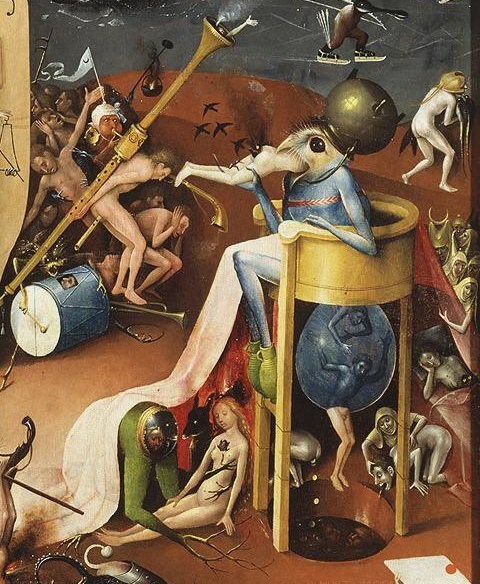
The Prince of Hell, from Bosch's Garden of Earthly Delights
Given their already notable impact on the genre, can these eccentric painters of the sixteenth century teach creators of fantasy anything today or add anything new to how we treat hellscape-style subjects? I think they can, especially when it comes to our depictions of demonic creatures. The dazzling variety of beasts in the works of the two men is one of their crowning achievements. Their demons are not regimented or regular, even when they appear in armies - they are the unique horrors of unique contraventions of the moral order of the universe.
Despite this, depictions of the demonic in fantasy media have settled to some degree. Horror demons have a lot of variation, but primarily down the lines of body horror and lovecraftian tentacles: meanwhile fantasy imps, devils and demons have in many cases settled into the goat-horned, satyr-like devil depiction, or at least some other form of humanoid. Tabletop gaming perhaps further builds on this perception, by presenting regular ranks of, to take two Warhammer examples, "bloodletters" or "plaguebearers", all of whom are essentially similar in style and function. If I say "demon" to you, you probably expect a pointed tail, red skin, perhaps a prodding weapon like a trident. Whilst it's great to have such an evocative image available, it feels like there's more that could be done to play around with those ideas.
Reintroducing a much wider conception of flat out weird demons and what they look like has a bunch of advantages for any creative work that touches on the subject. As such, here's three key ideas for how to use Bosch-style demon ideas in your creative work.
Firstly, ditch the humanoid body plans. Some of Bosch's stuff may be more body horror than you want in a fantasy campaign, but there's plenty that isn't, especially among the smaller demons he depicts. There are a few broad categories here it's worth thinking about: firstly, chimera-type demons, with animal heads, bodies, or both; secondly, blemmye types, where the order and number of humanoid body parts is edited, but in a way that is grotesque rather than horrific; thirdly, combination types, where a demon is heavily associated with a non-animal item, such as a walking helmet or a creature with knives for feet; and finally, a particular specialism in the bosch oeuvre, cavity types, where a creature's body is hollow and actually contains something else, be that a smaller demon or a useful/important item or similar.
Many of these are also great from a storytelling perspective compared to a "standard" demon. Chimera-types create an interesting mix of absurdity alongside malice, especially those with animal bodies and human heads. Their animal parts might be meant to exaggerate the extent to which they're a reversal of the norms - a fish or a chicken attacking a human, for example - or they might give clues as to a demon's character or goals (a conniving fish-demon or a cowardly chicken-headed demon might be fun for example). These things are done best when they're done with the most every-day things possible. There's something much more unsettling about a demon with spoons for feet and forks for hands than one with giant iron maxes for feet and swords for hands, because the former demon takes things we associate with normality and safety and puts a twist on them, rather than things we associate with danger already. Different body forms can also make a big difference to what you want players to think about a creature: a small creature, such as you might get from having a walking head with feet and a tail, is going to feel inherently less dangerous to the extent that it might almost be cute. Enlarging human anatomical items for example, like making the mouth of part of hell the literal mouth of a monster, is gross and definitely fully into the demonic idea. Finally, the demons-with-cavities idea that Bosch and Breugel both used is well worth considering: if a demon visibly is, say, carrying a vital artefact inside their body space, then the characters can get a visible reminder of what they're doing without encumbering the demon with having to waste a hand carrying it.

Demons need something to do - this sad guy from Breugel's Dulle Griet at least has a hobby!
Third, link demons to what they're doing in form. This is an area where the D&D alignment system has done more harm than good, by promoting a subdivision of demonic creatures where the primary differentiating feature is their attitude to the law/chaos axis of the graph. This then encourages demonic beings to be presented first within that framework and then given other attributes secondarily, whereas ideas like the classic deadly sins, or the circles of hell, might be significantly better organising principles. Beside the iconic idea of the succubus, there are surprisingly few demonic creatures that spring to mind that are really designed as a direct representation of other sins, despite the fact that these by definition lend themselves to interesting plot-hooks and visuals: imagine an avarice demon with a cavity body into which it pours money, an envy demon that takes on the visual form of the strongest enemy present, or a gluttony demon with two extra arms devoted to stuffing its face full of meat.

Breugel's sin of pride - note the bizarre buildings that form the background.
Finally, give demons a suitable environment. The thing that really hammers Bosch's hell into place isn't the demons so much as the fact that they're living in such a rich environment that has all the same upended madness that they themselves embody. We're perhaps too used to just thinking of hell/underworld locations as grim and firey and full of things that kill you. In fact, hell doesn't need lots of things in it that kill people, for the simple reason that most people who get there are decidedly past the point where that would be a significant concern to them. Rather, hell is about messing with their immortal souls - a place of buildings jumbled together in utterly wrong ways, clocks running backwards and forwards alternately every time you look at them, people living in bottles and the open mouths of giants and ships on land and castles in the sea. The overall theming of a hellscape is often done well, but the richness and maddening detail of these fifteenth and sixteenth century depictions is something that could be very usefully brought into more fantasy writing and settings as well.
So there you have it. I hope that this has given you some good ideas for demons - let me know if you liked it, or if you know any good recent examples of Bosch-style demons in fantasy settings, by commenting below!